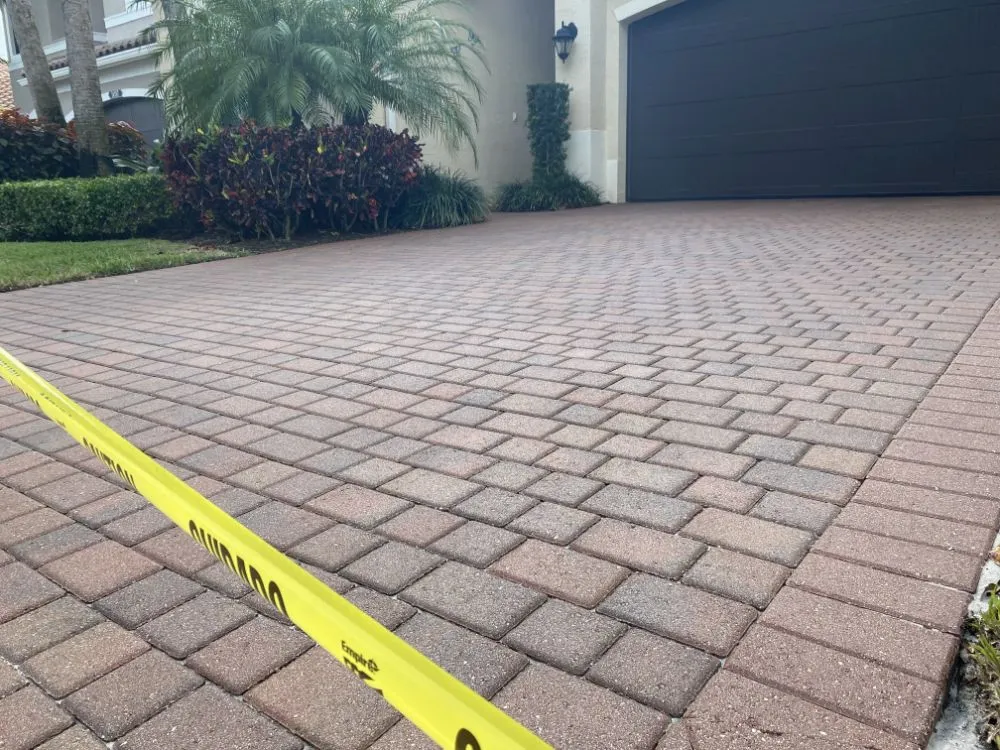
Indiana courthouse squares are among the most prominent and heavily trafficked paver installations in any municipality. They surround the seat of local government, anchor downtown commercial districts, and serve as the primary ceremonial public spaces for communities across the state. They are also among the most vulnerable paver installations to ADA violations — a consequence of age, relentless foot and vehicle traffic, tree root intrusion, and decades of deferred maintenance budgets that treated cosmetic appearance as adequate evidence of structural and accessibility health. Of the twelve cities and towns within the Paladin Pavers service corridor, ten have historic courthouse squares featuring brick or stone paver installations. This case study examines a representative courthouse square restoration project — a composite drawn from the common conditions, challenge patterns, and resolution pathways our team has encountered across multiple Central Indiana courthouse square engagements. The project described here reflects a typical scope: a mid-sized county seat with an aging brick paver surface, a documented ADA Transition Plan barrier inventory, and a public works department seeking to resolve compliance obligations within a constrained annual capital budget.
Project Background: A Typical Indiana Courthouse Square
The courthouse square in this composite scenario encompasses approximately 15,000 square feet of clay brick paver surface installed in the early 2000s as part of a downtown revitalization initiative funded through a combination of CDBG grants and local tax increment financing. At installation, the surface met the 2010 ADA Standards for Accessible Design and provided a firm, stable, slip-resistant pedestrian environment surrounding the county courthouse and connecting to downtown retail corridors on all four sides. By the time Paladin Pavers was engaged, the installation was more than twenty years old — approaching the end of its expected service life for the original joint sand and well into the period when frost heave damage accumulates fastest in Central Indiana clay soils.
The county's most recent ADA Transition Plan update, completed in partnership with the regional Metropolitan Planning Organization, had documented the courthouse square as a priority remediation site. The barrier inventory identified multiple ADA non-conformances, including trip hazards created by differential paver settling and frost heave displacement, eroded joint sand allowing joint widths to exceed the 1/2-inch maximum in several sections, cross-slope violations on sections adjacent to tree wells where root growth had displaced the subbase, and missing detectable warning surfaces at two of the six curb ramps surrounding the square. The county's ADA Coordinator had received two citizen accessibility complaints in the preceding 18 months — a legally significant threshold that escalates potential federal enforcement exposure from passive monitoring to active investigation.
Initial Assessment and ADA Compliance Audit
Paladin Pavers conducted a comprehensive pre-repair ADA compliance audit of the courthouse square surface over two days, using a protocol designed to produce documentation suitable for both the county's ADA Transition Plan and as a legal record of pre-remediation conditions. The assessment team deployed a digital profilometer to measure vertical displacements between adjacent paver units at a systematic grid of measurement points spaced every four feet across the entire 15,000-square-foot surface. A calibrated digital inclinometer recorded cross-slope and running-slope values at 25-foot intervals along every primary pedestrian route crossing the square. Each curb ramp was photographed, dimensioned, and evaluated against PROWAG R304 (curb ramp) and PROWAG R305 (detectable warning surface) requirements. Joint widths were measured using feeler gauges at 200 documented sample locations.
The audit identified 47 discrete trip hazards with vertical displacements exceeding the 1/4-inch ADA threshold — 31 in the range of 1/4 to 1/2 inch requiring beveling or re-leveling, and 16 exceeding 1/2 inch requiring full re-leveling with subbase correction. Slope analysis revealed 9 cross-slope violations exceeding 2.08 percent, all concentrated in the tree well zones on the north and east sides of the square where root growth had created domed distortions in the paver surface. Joint width violations (gaps exceeding 1/2 inch) were documented in 38 measurement locations, predominantly in the high-traffic pedestrian corridors connecting the main courthouse entrance to the surrounding sidewalks. The two missing detectable warning surfaces at curb ramps 3 and 5, previously noted in the ADA Transition Plan, were confirmed, along with two additional curb ramps (1 and 4) where existing detectable warning panels had cracked and separated from the substrate — rendering them non-compliant under PROWAG R305.2 durability requirements. All findings were compiled into a GPS-referenced barrier inventory delivered in both PDF report and GIS shapefile format for direct import into the county's infrastructure asset management database.
Scope Development and Phased Approach
Given the courthouse square's central role in county government operations and downtown commerce, the project was structured as a two-phase engagement specifically designed to maintain continuous pedestrian access throughout construction. Phase 1 addressed all ADA-critical hazards on the primary pedestrian access routes — the four main entry corridors from each surrounding street to the courthouse entrance, the curb ramps at all six intersections, and the detectable warning surfaces. Phase 1 also included the 16 most severe trip hazard repairs (displacements exceeding 1/2 inch) regardless of their location on primary or secondary routes, as these represented the highest immediate liability exposure. Phase 2 addressed the remaining trip hazards on secondary routes, the cross-slope corrections in the tree well zones, the joint sand restoration across the full surface, and the perimeter aesthetic repairs where paver units had chipped, cracked, or faded beyond acceptable appearance standards.
The phasing plan was developed in direct consultation with the county courthouse administrator and the downtown business association to identify construction windows that minimized impact on high-attendance events such as court docket days, the weekly farmers market, and summer evening programming in the square. Phase 1 was scheduled over three weeks in early spring before the farmers market season, with daily construction hours from 6:00 a.m. to 2:00 p.m. to allow the square to reopen to full pedestrian use each afternoon. ADA-compliant temporary pedestrian routes — minimum 4 feet wide with level surfaces, edge protection, and directional signage compliant with MUTCD Chapter 6D — were maintained at all times around active work zones. Phase 2 followed in late summer, timed between court recesses, using a rotating closure pattern that kept at least two of the four main entry corridors open simultaneously throughout the work period.
Repair Methods and Materials
Trip hazard remediation on paver surfaces requires a fundamentally different approach than concrete or asphalt patching. Each repair begins with the careful extraction of the displaced paver units using hand tools to avoid damaging adjacent units, followed by excavation of the affected subbase to a depth sufficient to address the root cause of displacement — typically 4 to 8 inches below the bedding sand layer for frost heave and root-related failures. The subbase was re-graded to design profile, compacted to 95 percent modified Proctor density using a plate compactor, and re-profiled with a 1-inch bedding sand layer screeded to the correct grade before paver reinstallation. All replacement pavers were sourced from the original manufacturer's current production run where possible; where exact matches were unavailable, the closest available unit was installed in a location that would be covered by the polymeric sand restoration, minimizing visual contrast.
Detectable warning surface installation at all six curb ramps used cast-in-place composite panels specified from the INDOT Qualified Products List — the required specification for any project within the state right-of-way abutting the courthouse square, and the specification Paladin Pavers recommends for all municipal installations given INDOT's rigorous QPL evaluation process. Panels were installed with epoxy adhesive on a prepared mortar setting bed, meeting PROWAG R305 requirements for dome geometry (0.9-inch base diameter, 0.2-inch height, 1.6-inch center-to-center spacing), color contrast (safety yellow against the red-brown brick paver field), and dimensional coverage (full width of the curb ramp, minimum 24-inch depth in the direction of travel). Joint sand restoration across the full 15,000-square-foot surface used a polymeric sand meeting ASTM C144 gradation requirements, activated with water per manufacturer's specifications and allowed to fully cure before reopening to traffic. All materials, delivery tickets, and quality control test data were compiled into the project closeout documentation package.
Results and Compliance Verification
Post-repair ADA compliance verification was conducted using the same measurement protocol as the initial audit, producing a point-for-point comparison record for every documented non-conformance. The results confirmed full remediation of all 47 trip hazards: zero vertical displacements exceeding 1/4 inch were detected at any of the original 47 hazard locations or at any point within the systematic post-repair grid survey. All nine cross-slope violations were resolved, with post-repair inclinometer readings ranging from 0.8 to 1.7 percent at the previously non-compliant locations — all within the 2.08-percent maximum. All six curb ramps were verified against PROWAG R304 dimensional requirements (running slope, cross slope, width, flare angles) and PROWAG R305 detectable warning specifications (dome geometry, color contrast, dimensional coverage). Joint width measurements at all 38 previously non-compliant locations confirmed gaps within the 1/2-inch maximum following polymeric sand restoration.
The complete post-repair compliance verification report — including GPS-referenced before-and-after photographs, measurement data tables, and a signed engineer's attestation — was delivered to the county ADA Coordinator within 10 business days of Phase 2 completion. The documentation package was formatted for direct insertion into the county's ADA Transition Plan barrier inventory as a compliance closure record, removing all 47 trip hazards, 9 slope violations, 38 joint violations, and 4 detectable warning deficiencies from the open-barrier registry. The county was able to submit the updated barrier inventory to the regional MPO as part of its annual ADA Transition Plan progress report, documenting measurable progress toward the federal compliance mandate and reducing the risk profile for DOJ enforcement monitoring.
Budget and Return on Investment
The total project cost across Phase 1 and Phase 2 was approximately $85,000 — $52,000 for Phase 1 (primary routes, all curb ramps and DWS, 16 critical hazard repairs) and $33,000 for Phase 2 (secondary routes, slope corrections, joint sand restoration, aesthetic repairs). This figure reflects a mid-sized courthouse square in a county seat community; comparable projects in larger cities with more complex traffic management requirements and higher paver square footage would carry proportionally higher costs, while smaller town squares have been completed for significantly less. Against the cost of inaction, the financial calculus is unambiguous: a single federal ADA violation — one finding by DOJ following a complaint investigation — carries a first-offense civil penalty of up to $75,000 and a subsequent-violation penalty of up to $150,000. The county had two documented citizen accessibility complaints on file, meaning the courthouse square had already cleared the threshold where DOJ could reasonably classify any future finding as a subsequent violation.
More significant still is the tort liability exposure that the documented trip hazards created. Personal injury settlements from trip-and-fall incidents on non-compliant municipal paver surfaces range widely, but Central Indiana municipal attorneys have cited settlement ranges of $75,000 to $500,000 for soft-tissue and fracture injuries, and multi-million-dollar exposure for incidents involving permanent disability. A municipality with a documented barrier inventory showing known trip hazards — and a gap between barrier identification and remediation — faces a heightened negligence standard in any subsequent personal injury claim. The $85,000 project cost is best understood not as a capital expenditure but as a risk management investment that eliminated potential liability exposure conservatively estimated at $500,000 to $1,500,000 across the project's useful life. The county subsequently enrolled in Paladin Pavers's annual maintenance program at approximately $8,000 per year — a predictable operating expense that prevents the accumulation of deferred maintenance and keeps the surface in continuous ADA compliance between full-scope restoration cycles.